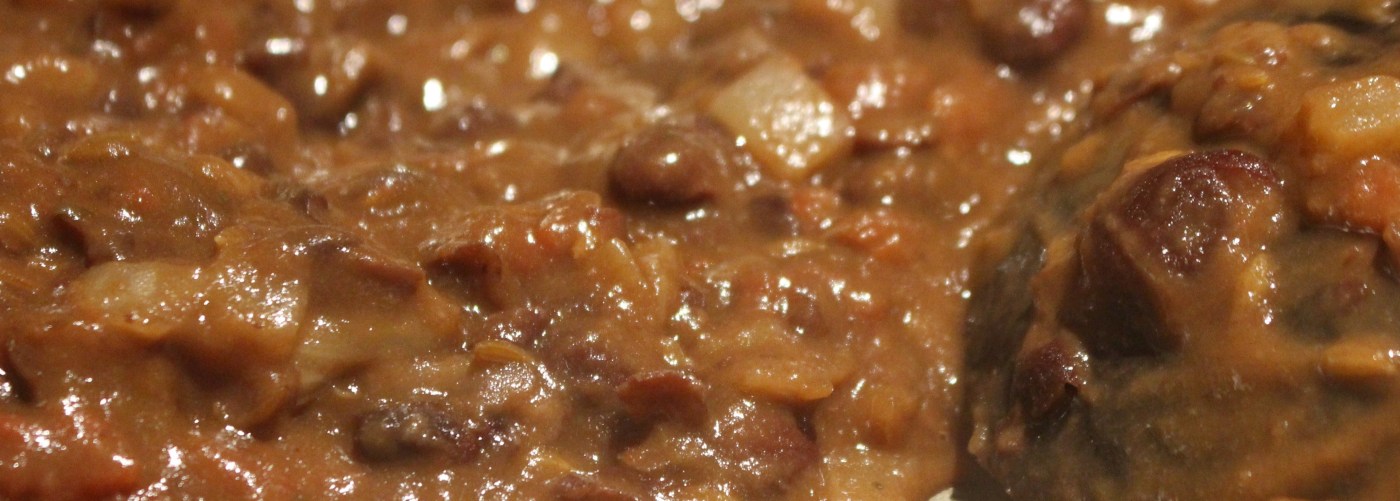
It’s difficult to say when this concoction was first created. It’s a recipe that never seems to have an endpoint. There is always something added to make it that much more extreme and that much better. Leftover pork/brisket/duck fat? Put that in. Tomatoes with chilis? Sounds good. Even while writing this I’m thinking of the next step in beans… Mango Habanero Beans (Sweet and spicy? Yes, please).
For most, making beans is easy; open the can, heat them up, and serve. That might be fine for some, but for those who expect more, this recipe is quite easy and never disappoints. The best part about this is that you can take the fundamental ingredients and apply them across any type of bean: black beans, pinto beans, red beans, baked beans (probably not fava beans, but who knows…).
Ingredients:
- 2
 Cans black beans (preferably low sodium, you can add salt later)
 - 1 Can diced tomatoes (with green chilies if you like a kick)
- Cumin seeds
- White wine vinegar
- Olive oil
- 1 Purple onion
- 3 Bay leaves
- Salt
Step 1: Dice the onions.
Did you know there was a proper way to dice an onion? Me neither. (A really nice how to can be found here). I struggled for the longest time with this method, but once I got the hang of it, there was no going back. I have yet to find another way to uniformly chop an onion, which is key to having it cook evenly.
Step 2: Toast the cumin seeds.
If you read the ingredients abo ve and thought to yourself, “I’ll just use my ground Cumin for this”, STOP. NOW. Do 3 things: 1) Order a spice (coffee) grinder. 2) Go to the grocery store to the international section. Find Badia brand whole cumin for 70 cents a pop. 3) Order a larger package from Penzeys – its higher quality. (The Badia will get you by for now). Toast your whole seeds in a dry pan on medium high heat. Don’t allow the seeds to burn, rather look for them to start turning slightly darker. As they darken, the smell of toasty cumin will emerge. Remove them from the heat, they are done. Note: For this recipe, I keep my cumin whole, however, if you prefer ground cumin, do so now.

Step 3: Saute the onion.
 Add olive oil to the pan, along with the toasted cumin. Heat the oil, but do not bring it to the smoking point. Toss in the onions, along with a few pinches of salt. The salt will help the onion release moisture and allow the sugars in the onion to caramelize. Saute the onion until they start to brown around the edges. This might take a bit, but continue to toss them around every few seconds until they begin to brown. If the onions begin to stick to the pan, add a splash of red or white vinegar to deglaze any brown bits that are sticking. All of this adds to the flavor.

Step 4: Add the remaining ingredients and simmer.
 Add the cans of tomatoes, black beans (do not strain the cans), bay leaves, and a little more vinegar. Stir to mix. Leave it on a low to medium heat to keep it simmering. The longer it cooks, the better. The goal is to reduce the moisture in the pan until the beans really start to thicken. If you are in a hurry you can turn the heat up, but you’ll need to keep
  an eye on it and keep stirring to make sure nothing burns. I like to leave it at a simmer and check it every 10 to 15 minutes and stir. Make sure any bits that might be trying to stick to the pan are scraped and stirred. Each time the beans are stirred, mash some of the beans up with the spoon. This will help the sauce thicken. Feel free to taste, but don’t add any salt yet. As the beans reduce, the salt is going to concentrate. Eventually the sauce will be so thick that when stirred it won’t flow back into place. Add salt at this time, if needed. Take the pan off the heat and cover until serving time. Congrats! The beans are finished. Now, where did I put my mojito?


 Rough Measurements